
United States Rail Freight Transport Market to Reach USD 87.42 Billion by 2031, Driven by Intermodal Growth and Cross-Border Trade, Says Mordor Intelligence
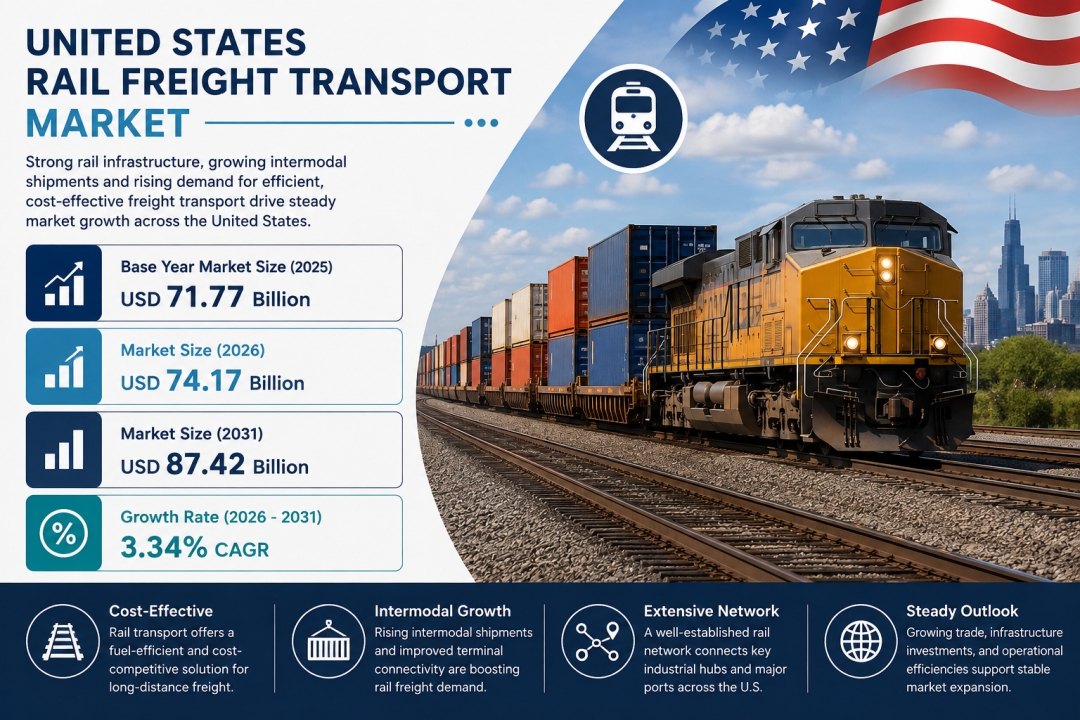
US Rail Freight Transport Market Overview
According to Mordor Intelligence, the United States Rail Freight Transport Market is estimated at USD 74.17 billion in 2026, compared with USD 71.77 billion in 2025, and is projected to reach USD 87.42 billion by 2031, registering a 3.34% CAGR during 2026-2031. The market continues to benefit from the important role of rail in moving bulk commodities, containerized freight, industrial materials, agricultural products, and chemicals across the country.
Rail remains closely connected to the broader supply chain, particularly where long-distance freight movement requires efficient transportation between ports, inland logistics hubs, manufacturing centers, agricultural regions, and major consumption markets. The expansion of e-commerce supply chains is supporting intermodal activity, while investment in rail infrastructure is helping carriers address capacity requirements and improve network performance.
The market is also experiencing changes in its cargo mix. Traditional bulk freight remains important, but intermodal transportation, agricultural commodities, chemicals, retail shipments, and project cargo are creating additional opportunities. At the same time, rail operators are focusing on service dependability, asset utilization, terminal performance, and customer visibility to retain and attract freight that can move through competing transportation modes.
United States Rail Freight Transport Market Growth Drivers
Intermodal Freight Supports Market Growth
Intermodal transportation remains a major contributor to the United States Rail Freight Transport Market as retailers and logistics providers seek efficient ways to manage long-distance freight movements. The continued development of e-commerce supply chains has increased the importance of moving containers between coastal gateways, inland terminals, distribution centers, and consumer markets.
Railroads are responding by expanding intermodal terminal capabilities and improving connections between rail networks and other modes of transportation. Inland logistics hubs and rail-served distribution facilities are also supporting the movement of imported and domestic goods. For shippers, rail can provide an effective option for long-distance transportation while helping manage supply-chain costs and capacity requirements.
The growing importance of service reliability is another factor influencing intermodal demand. Consistent schedules, improved terminal operations, and shipment visibility can help rail operators compete more effectively with trucking for freight that requires dependable delivery.
Infrastructure Investment and Network Capacity
Investment in rail infrastructure is another important factor influencing the United States Rail Freight Transport Industry. Track improvements, siding extensions, corridor upgrades, grade-separation projects, and terminal development can increase network capacity and help reduce bottlenecks.
Federal infrastructure funding is supporting projects designed to improve freight movement across important corridors. Rail operators are also directing capital toward network maintenance, intermodal facilities, and operational improvements. These investments are important as carriers manage increasing demand across different freight categories while seeking better asset utilization.
Capacity improvements can also support more dependable service by allowing trains to move through congested sections of the network with fewer operational constraints. As freight flows change across regions and commodities, flexible infrastructure will remain important to the long-term market outlook.
Changing Commodity Mix and Cross-Border Freight
The cargo mix within the United States Rail Freight Transport Market is becoming more diversified. Intermodal freight remains important, while dry bulk transportation continues to serve agriculture, minerals, and other industries. Changes in coal demand are encouraging railroads to place greater attention on grains, aggregates, chemicals, and other commodities.
Agricultural freight is supported by domestic production and cross-border trade, particularly flows connecting the United States with Canada. Rail provides an important link between agricultural regions, processing facilities, export gateways, and industrial customers.
Cross-border transportation is also gaining attention as integrated rail networks connect the United States with neighboring markets. The development of cross-border logistics corridors can improve supply-chain connectivity and create opportunities for freight associated with agriculture, manufacturing, automotive activity, and other industries.
Alternative Traction and Operational Efficiency
The United States Rail Freight Transport Industry is also examining alternative traction technologies as carriers seek to improve fuel efficiency and reduce emissions. Diesel remains widely used across freight operations, but interest in hybrid, hydrogen, and LNG-based locomotive technologies is increasing.
Alternative traction initiatives are being explored across different operational applications, including yard operations and freight transportation. These technologies may provide railroads with additional options for managing fuel consumption and emissions while maintaining freight performance.
Operational efficiency remains equally important. Railroads are applying precision scheduled railroading practices, predictive maintenance, digital shipment visibility, and improved asset management to strengthen network utilization. These measures can help carriers reduce delays, improve equipment availability, and respond more effectively to customer requirements.
Check out more details and stay updated with the latest industry trends, including the Japanese version for localized insights: https://www.mordorintelligence.com/ja/industry-reports/united-states-rail-freight-transport-market?utm_source=abnewswire
United States Rail Freight Transport Market Segmentation
The United States Rail Freight Transport Market is segmented by cargo type, service type, end-user industry, traction type, and destination. This segmentation reflects the diverse range of freight handled across the national rail network.
By Cargo Type:
-
Containerised / Intermodal
-
Dry Bulk, including coal, ores, and grains
-
Liquid Bulk, including crude and chemicals
-
Break-bulk and project cargo
Intermodal transportation represents an important part of demand, while dry and liquid bulk movements continue to support major industrial and agricultural supply chains. Break-bulk and project cargo provide opportunities linked to specialized freight requirements.
By Service Type:
-
Transportation
-
Services Allied to Transportation
Transportation remains the core market activity, while allied services include activities such as railcar and track maintenance, cargo switching, and storage. The broader service offering allows rail operators and related providers to address more supply-chain requirements.
By End User:
-
Mining and Minerals
-
Oil, Gas and Chemicals
-
Agriculture and Food
-
Manufacturing and Automotive
-
Retail and FMCG
-
Construction Materials and Others
By Traction Type:
-
Diesel
-
Electric
-
Hybrid / Hydrogen and LNG
By Destination:
-
Domestic
-
International / Cross-border
This segmentation highlights the broad customer base served by rail freight, ranging from commodity producers and manufacturers to retailers, agricultural businesses, and cross-border shippers.
Explore Our Full Library of Logistics Research Reports: https://www.mordorintelligence.com/market-analysis/logistics?utm_source=abnewswire
United States Rail Freight Transport Market Key Players
The competitive landscape includes major Class I railroads with extensive networks and established customer relationships. Union Pacific Railroad, BNSF Railway, CSX Transportation, Norfolk Southern Railway, and Canadian Pacific Kansas City are among the key players identified in the market.
These companies compete through network coverage, freight capacity, intermodal services, customer relationships, operational efficiency, and infrastructure investment. Their strategies increasingly emphasize service reliability and shipment visibility alongside traditional cost and network advantages.
The competitive environment also includes regional and short-line railroads that connect smaller markets with larger rail networks. These operators support first- and last-mile freight requirements and contribute to the wider connectivity of the national rail system.
United States Rail Freight Transport Market Outlook
The United States Rail Freight Transport Market is positioned for continued growth as railroads respond to changing freight requirements, expanding intermodal activity, infrastructure investment, and evolving trade flows. The diversification of cargo beyond traditional bulk commodities is creating a broader base of demand for rail transportation.
Intermodal freight, cross-border agricultural movements, chemicals, retail shipments, and specialized cargo are expected to remain important areas of opportunity. At the same time, infrastructure upgrades and operational improvements will be essential for maintaining network capacity and service quality.
As carriers continue to improve efficiency and explore alternative traction technologies, the market is expected to remain an important component of the country’s freight transportation system. The combination of established rail infrastructure, diversified cargo demand, and ongoing investment provides a stable foundation for the market’s forecast period.
For more insights on the United States Rail Freight Transport Market, please visit the Mordor Intelligence page: https://www.mordorintelligence.com/industry-reports/united-states-rail-freight-transport-market?utm_source=abnewswire
Industry Related Reports:
Global Maritime Freight Transport Market Size: The Maritime Freight Transport Market was valued at USD 599.78 billion in 2025 and is projected to increase from USD 632.36 billion in 2026 to USD 823.57 billion by 2031, expanding at a CAGR of 5.43% during 2026–2031. Market growth is supported by resilient global trade, longer vessel routes caused by congestion and geopolitical disruptions, and the growing movement of goods along South-South trade corridors. These shifts are increasing ton-mile demand while strengthening intra-Asian maritime freight activity.
Get more insights: https://www.mordorintelligence.com/industry-reports/global-maritime-freight-transport-market?utm_source=abnewswire
Global Air Freight Market Analysis: The Air Freight Market is segmented by service, including freight transport and freight forwarding; destination, covering domestic and international markets; carrier type, comprising belly cargo and freighter operations; cargo type, including general cargo and special cargo; end-user industry, such as e-commerce and retail, manufacturing and automotive, and others; and geography, covering North America, Asia-Pacific, Europe, and other regions. The market forecasts are provided in terms of value (USD).
Get more insights: https://www.mordorintelligence.com/industry-reports/global-air-freight-market?utm_source=abnewswire
About Mordor Intelligence:
Mordor Intelligence is a trusted partner for businesses seeking comprehensive and actionable market intelligence. Our global reach, expert team, and tailored solutions empower organizations and individuals to make informed decisions, navigate complex markets, and achieve their strategic goals.
With a team of over 550 domain experts and on-ground specialists spanning 150+ countries, Mordor Intelligence possesses a unique understanding of the global business landscape. This expertise translates into comprehensive syndicated and custom research reports covering a wide spectrum of industries, including aerospace & defense, agriculture, animal nutrition and wellness, automation, automotive, chemicals & materials, consumer goods & services, electronics, energy & power, financial services, food & beverages, healthcare, hospitality & tourism, information & communications technology, investment opportunities, and logistics.
For any inquiries or to access the full report, please contact:
https://www.mordorintelligence.com/
Mordor Intelligence, 11th Floor, Rajapushpa Summit, Nanakramguda Rd, Financial District, Gachibowli, Hyderabad, Telangana – 500032, India.
Media Contact
Company Name: Mordor Intelligence
Contact Person: Jignesh Thakkar
Email: Send Email
Phone: +1 617-765-2493
Address:11th Floor, Rajapushpa Summit, Nanakramguda Rd, Financial District, Gachibowli [email protected]
City: Hyderabad
State: Telangana 500008
Country: India
Website: https://www.mordorintelligence.com/


